Water Rates Increasing for Cal American Users

Some California American Water (Cal Am) customers could see their water bills quadruple shortly. The rates were approved in July by the Public Utilities Commission, and will force the biggest water users to change their habits or pay more than ever.

Additionally, the majority of Cal Am customers will see an increase of 20%, resulting in an average monthly increase of $2.81. For about one in 10 customers, bills should stay the same or go down, while the majority of customers–62%–will see their bills increase by at least 20%.

Certain areas will be placed on a water allotment. Another change is that customers will be billed according to every 10 cubic feet of water used. Under the old rate system, customers were billed according to every 100 cubic feet of water.

The intent of the new rates is to discourage water waste and to foster conservative landscape irrigation practices, water officials said.

Los Angeles Water Recapture Law

heavy-rainfall1

I have been a proponent of water conservation for 25 years and am more active than ever in promoting the proper use of irrigation in our community.  I have found that most people are conscious of the need to be conservative water users, but there really is no incentive for many others not to save water.  In these cases, stricter restrictions may be necessary.  However, those of us that have been saving water for years, should not be penalized for not being able to save more than is reasonable.  The City of Los Angeles is proposing a law that would require us to save more water when it is raining than nature itself can.

Los Angeles may require storm water recapture beginning in 2011, but the proposed law may have gone to the extreme.

The fairly new approach to managing storm water and urban runoff is designed to mitigate the negative effects of urbanization by controlling runoff at its source, which is parking lots, rooftops, driveways and streets, with small, cost-effective natural systems instead of treatment facilities. These “natural” systems would be rain gardens for small parcels and holding ponds for larger areas.  But  “larger” areas that have no land for holding ponds will have to install not so natural underground holding and or dispersement systems.  And these systems are not small or cost effective.

The proposed law would require new homes, larger developments and some redevelopments in Los Angeles to capture and reuse runoff generated in rainstorms. Reducing this runoff improves water quality and recharges groundwater, which is a great thing.

The proposed ordinance approved in January by the Department of Public Works could go into effect by 2011 and would require such projects to capture, reuse or infiltrate 100 percent of runoff generated in a 3/4 -inch rainstorm or to pay a storm water pollution mitigation fee that would help fund off-site, low-impact public developments.

With a project I am consulting on right now, the developer will be installing a system sized to his water needs.  100% of the water necessary to irrigate his landscape during the dry season will be captured and held for use from the rainfall captured over the course of the entire winter season.  It is not realistically possible, either physically or financially to catch more than this on the available land, nor is there a reason to do so.

I do not understand how we should be forced to capture the 3/4 inch rainfall amount to be mitigated if it is more than nature itself can save.  Runoff in our local foothills can occur with as little as 1/4 inch of rain. And what do you do if you have a 3/4 inch rain event followed closely by a second event?  It is unreasonable to have to trap 1-1 1/2 inches of water under ground until it can infiltrate into the ground or be used.

LA Board of Public Works Commissioner Paula Daniels, who drafted the ordinance last July, said the new requirements would prevent 104 million gallons of polluted urban runoff from ending up in the ocean. Under the ordinance, builders would be required to use rainwater storage tanks, permeable pavement, infiltration swales or curb bump-outs to manage the water where it falls. Builders unable to manage 100 percent of a project’s runoff on site would be required to pay a penalty of $13 a gallon of runoff not handled there—a requirement the Building Industry Assn. has been fighting.

Some building projects, such as those in downtown L.A. or areas where the soil is high in clay, would have difficulty with the 100 percent retention rule and that the $13-a-gallon mitigation fee is too high. A one-acre building on ground where runoff could not be managed on site, Schroeder said, could pay a fee as high as $238,000.

Realistically, storing water for our use during the dry season, installing rain gardens to hold water so that it can infiltrate into the ground naturally and being conservative with the use of our water is what we should be doing now.  Being penalized for mother nature raining ¾ inch at a time is unrealistic.

Los Angeles Homeowners Must Maintain Their Own Trees

A budget shortfall may force major changes in the City of Los Angeles that could affect the maintenance of trees along the city streets and parks.

Homeowners in LA may have to maintain their own trees

Los Angeles’ top budget analyst, Miguel Santana, is urging council members to focus on very bracing financial challenges in the years ahead which would include outsourcing landscape maintenance operations normally done by city workers.

The Los Angeles City Council could vote this week on whether to proceed with the elimination of 1,000 positions to address this year’s $208-million deficit and the city’s dwindling reserve fund. Santana urged city officials to immediately begin seeking private contractors for the convention center, municipal golf courses, city parking garages and the zoo. For example, a proposed pilot program in the parks department would contract out 20 percent of its landscaping duties. And L.A. residents could soon see some unpleasant changes.

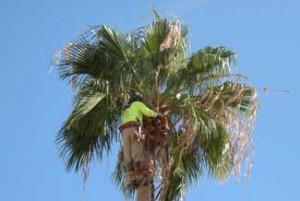
Tree trimming may no longer be a service that Angelenos can count on. Because of prior budget cuts, very few of the city’s palm trees will be trimmed this year, according to the report. In the future, the city’s top budget analyst is asking City Council members to consider reducing the costs of street tree trimming “to the bare minimum” and returning “responsibility for street tree maintenance to the abutting property owner,” as was the case before a change to city law in 1931.

Error in University Turf Study Voids Negative Conclusion About Turf Grass

I read a turf study that came came out of the University of California Irvine that just did not make sense to me, so I did some homework.

Basically, UCI came to the conclusion that urban turf contributes to global warming. Now, I am a user of lawns, vendor of turf maintenance products and we support many companies that maintain turf. But, for over 25 years I have promoted sensible use of all plants in the landscape, including turf grasses. You will not find a single landscape in my portfolio that is wall to wall grass. Therefore, I feel I am unbiased by either the promoters of grass and sod products or those adamant that artificial turf or rock is the way of the future. Come to think of it, the artificial turf product manufacturers should be more wary of this study than the natural grass industry.

First is the rebuttal press release-

Monday, February 22,2010
Error in Turf Study Voids Conclusion

The University of California, Irvine, has acknowledged a computation error in their recently released study entitled, “Carbon Sequestration and Greenhouse Gas Emissions in Urban Turf.” The initial findings blamed common turf grass for contributing to global warming, but the findings were found to be based on incorrect data.

Upon review of the report, various flaws were discovered. The carbon from fuel consumption was multiplied by 12, one too many times, to convert from monthly to annual data. Another significant math error was made in computing the carbon consumed during mowing. When the computations were corrected, it was found that turfgrass actually is a net sequesterer of carbon dioxide, reversing the conclusions of the original report.

“The grass in your backyard is working hard to keep us cool, soak up carbon, capture particulates, produce oxygen, capture rain water and reduce run-off. We need to focus on the right plant in the right place and on management practices that maximize the environmental benefits potential of turfgrass,” said Kris Kiser, executive vice president of Outdoor Power Equipment Institute (OPEI).

OPEI also noted that the UCIrvine study did not acknowledge the dramatic reductions of emissions and fuel use profile for today’s gasoline and diesel equipment, nor did the study disclose what model equipment and corresponding fuel use numbers were used.

Here is the original release-

Be careful not to get this erroneous information into the hands of the wrong people.

Urban ‘Green’ Spaces May Contribute To Global Warming, UCI Study Finds

February 22, 2010

Irvine, CA – Dispelling the notion that urban “green” spaces help counteract greenhouse gas emissions, new research has found – in Southern California at least – that total emissions might be lower if lawns did not exist.

Turfgrass lawns help remove carbon dioxide from the atmosphere through photosynthesis and store it as organic carbon in soil, making them important “carbon sinks.” However, greenhouse gas emissions from fertilizer production, mowing, leaf blowing and other lawn management practices are similar to or greater than the amount of carbon stored by ornamental grass in parks, a UC Irvine study shows. These emissions include nitrous oxide released from soil after fertilization. Nitrous oxide is a greenhouse gas that’s 300 times more powerful than carbon dioxide, the Earth’s most problematic climate warmer.

“Lawns look great – they’re nice and green and healthy, and they’re photosynthesizing a lot of organic carbon. But the carbon-storing benefits of lawns can be counteracted by greenhouse gas emissions,” said Amy Townsend-Small, Earth system science postdoctoral researcher and lead author of the study, forthcoming in the journal Geophysical Research Letters.

The research results are important to greenhouse gas legislation being negotiated. “We need this kind of carbon accounting to help reduce global warming,” Townsend-Small said. “The current trend is to count the carbon sinks and forget about the greenhouse gas emissions, but it clearly isn’t enough.”

Turfgrass is increasingly widespread in urban areas and covers 1.9 percent of land in the continental U.S., making it the most common irrigated crop.

In the study, Townsend-Small and colleague Claudia Czimczik analyzed grass in four parks near Irvine, Calif. Each park contained two types of turf: ornamental lawns (picnic areas) that are largely undisturbed, and athletic fields (soccer and baseball) that are trampled and replanted and aerated frequently.

The researchers evaluated soil samples over time to ascertain carbon storage, or sequestration, and they determined nitrous oxide emissions by sampling air above the turf. Then they calculated carbon dioxide emissions resulting from fuel consumption, irrigation and fertilizer production using information about lawn upkeep from park officials and contractors.

The study showed that nitrous oxide emissions from lawns were comparable to those found in agricultural farms, which are among the largest emitters of nitrous oxide globally.

In ornamental lawns, nitrous oxide emissions from fertilization offset just 10 percent to 30 percent of carbon sequestration. But fossil fuel consumption for management, the researchers calculated, released almost as much or more carbon dioxide than the plots could take up, depending on management intensity. Athletic fields fared even worse, because – due to soil disruption by tilling and resodding – they didn’t trap nearly as much carbon as ornamental grass but required the same emissions-producing care.

“It’s unlikely for these lawns to act as net greenhouse gas sinks because too much energy is used to maintain them,” Townsend-Small concluded.

Previous studies have documented lawns storing carbon, but this research was the first to compare carbon sequestration to nitrous oxide and carbon dioxide emissions from lawn grooming practices.

The UCI study was supported by the Kearney Foundation of Soil Science and the U.S. Department of Agriculture.

SOURCE: University of California

So, math errors again factor into the global warming debacle.

What are your thoughts?

Frank